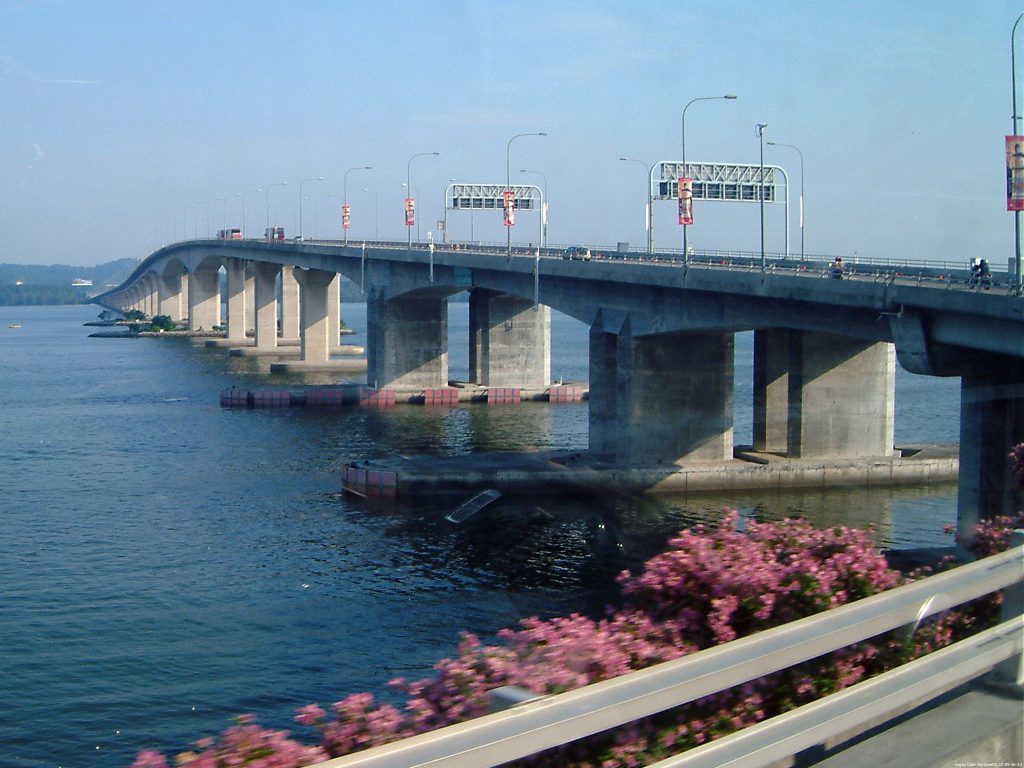

While most of the connectivity conversation around Johor Bahru focuses on the RTS Link, there is a separate and equally important infrastructure story that directly affects Iskandar Puteri: the ongoing expansion and upgrade of the Second Link checkpoint at Tuas. Here is what is happening, what the timeline looks like, and what faster clearance means for people who live — or plan to live — in Iskandar Puteri.
The Second Link vs. the Causeway: why they serve different populations
Johor Bahru has two land crossings into Singapore. The Johor-Singapore Causeway connects JB Town (Johor Bahru Customs, Immigration and Quarantine, or CIQ) to Woodlands in Singapore. The Second Link (Malaysia-Singapore Second Crossing) connects Gelang Patah in Iskandar Puteri to Tuas in western Singapore.
The two crossings serve meaningfully different commuter populations:
- The Causeway is used predominantly by commuters heading to central and eastern Singapore — the CBD, Orchard, Tampines, and the eastern industrial belt. It is also the main pedestrian crossing and is used by those taking public transport (buses).
- The Second Link is used predominantly by commuters heading to western Singapore — Jurong, Tuas Industrial Estate, Biopolis, one-north, and the western port and logistics cluster. It is almost entirely a car and commercial vehicle crossing; there is no rail connection and pedestrian crossing is minimal.
This distinction matters for property buyers. If you work in western Singapore — in biomedical, petrochemical, advanced manufacturing, or western logistics — the Second Link is your crossing. Iskandar Puteri, which sits 15–25 minutes from the Second Link, is your most logical residential option on the Malaysian side.
Current crossing times and the problem they represent
Under normal conditions, the Second Link is faster than the Causeway for car crossings — typically 15–40 minutes versus 45–90 minutes at the Causeway during peak hours. But “normal conditions” is doing significant work in that sentence. During public holidays, school holidays, Friday evenings, and Sunday evenings, Second Link queues extend to 60–90 minutes or more.
The unpredictability is the problem. A crossing that takes 20 minutes on a Tuesday morning but 80 minutes on a Friday afternoon creates commute planning uncertainty that discourages some buyers from committing to Iskandar Puteri as a permanent base, even when the average commute time is acceptable.
What the upgrade involves
The Sultan Abu Bakar Complex (KSAB) at the Second Link is undergoing a phased expansion as part of the infrastructure commitments under the JS-SEZ framework. The upgrade includes:
- Additional vehicle inspection lanes — expanding throughput capacity during peak periods
- Automated Vehicle Inspection System (AVIS) upgrades — reducing the time each vehicle spends at the inspection point
- MyRapid PLUS integration — improved bus and commercial vehicle processing to reduce queue spillback from lorry crossings onto private car lanes
- Expanded parking and holding areas — reducing the road-queue spillback that extends into Iskandar Puteri during peak periods
On the Singapore side, the Tuas Checkpoint (TCK) is also part of the broader Singapore Customs infrastructure development plan, with investment in automated lanes and passenger processing speed.
What faster clearance actually changes for residents
The impact of crossing time is non-linear. There is a threshold below which a commute becomes acceptable for daily use, and above which it does not. For most professionals, a door-to-door commute of under 60 minutes is acceptable for daily use. A commute that is reliably 45 minutes, even in peak conditions, is qualitatively different from one that averages 45 minutes but occasionally stretches to 90.
If the Second Link upgrade delivers more reliable clearance — not necessarily faster on average, but more predictable at the upper end — it expands the effective residential catchment for Iskandar Puteri meaningfully. Buyers who previously ruled out Iskandar Puteri because of the occasional nightmare crossing may recalculate.
The types of buyers most affected:
- Professionals working in Jurong Innovation District, Biopolis, or one-north, where crossing reliability matters for work start times
- Families with children, where school pickup times create hard constraints on commute unpredictability
- Senior executives with client-facing schedules who cannot absorb a 90-minute crossing without prior notice
The Second Link vs. RTS Link: different markets, not competitors
A common question from buyers is whether the RTS Link (which serves JB Town and Bukit Chagar, not Iskandar Puteri) makes the Second Link less relevant. The answer is no — they serve different populations.
The RTS Link is a rail service connecting JB Town to Woodlands North MRT, giving non-car commuters access to Singapore’s rail network. It benefits people who do not have a car, who work in central or eastern Singapore, or who want to avoid driving entirely.
The Second Link upgrade benefits people who drive, who work in western Singapore, and who live in Iskandar Puteri. These are largely separate populations. A buyer choosing between JB Town (for RTS access) and Iskandar Puteri (for landed space and Second Link proximity) is making a lifestyle choice, not a connectivity arbitrage. The Second Link upgrade makes the Iskandar Puteri option more reliable, which is relevant to that decision.
What buyers should watch for
The upgrade is being implemented in phases, and the full impact on crossing times will only be observable once completed. For buyers who are actively evaluating Iskandar Puteri based on commute time, the practical advice is:
- Test your actual crossing during your work schedule — drive the route at the time you would normally commute, on a representative weekday, before committing
- Check iClear or MyJPJ apps for real-time Second Link queue data, and track it over several weeks to understand the variance
- Factor in the Singapore-side journey — the crossing is only part of the commute; add your drive from Tuas checkpoint to your actual workplace in Singapore
- Ask about employer flexibility — many JS-SEZ employers and Singapore employers near Tuas offer staggered start times specifically to help employees manage the crossing; this changes the calculus significantly
The property angle
Reduced crossing time predictability is one of the structural constraints that has historically limited how aggressively Iskandar Puteri prices could run relative to JB Town. As the Second Link becomes more reliable, that constraint loosens. Properties in Iskandar Puteri that are specifically well-positioned for the Tuas corridor — particularly those in the western precincts of Eco Botanic and Horizon Hills closest to the Gelang Patah interchange — stand to benefit most from sustained crossing time improvement.