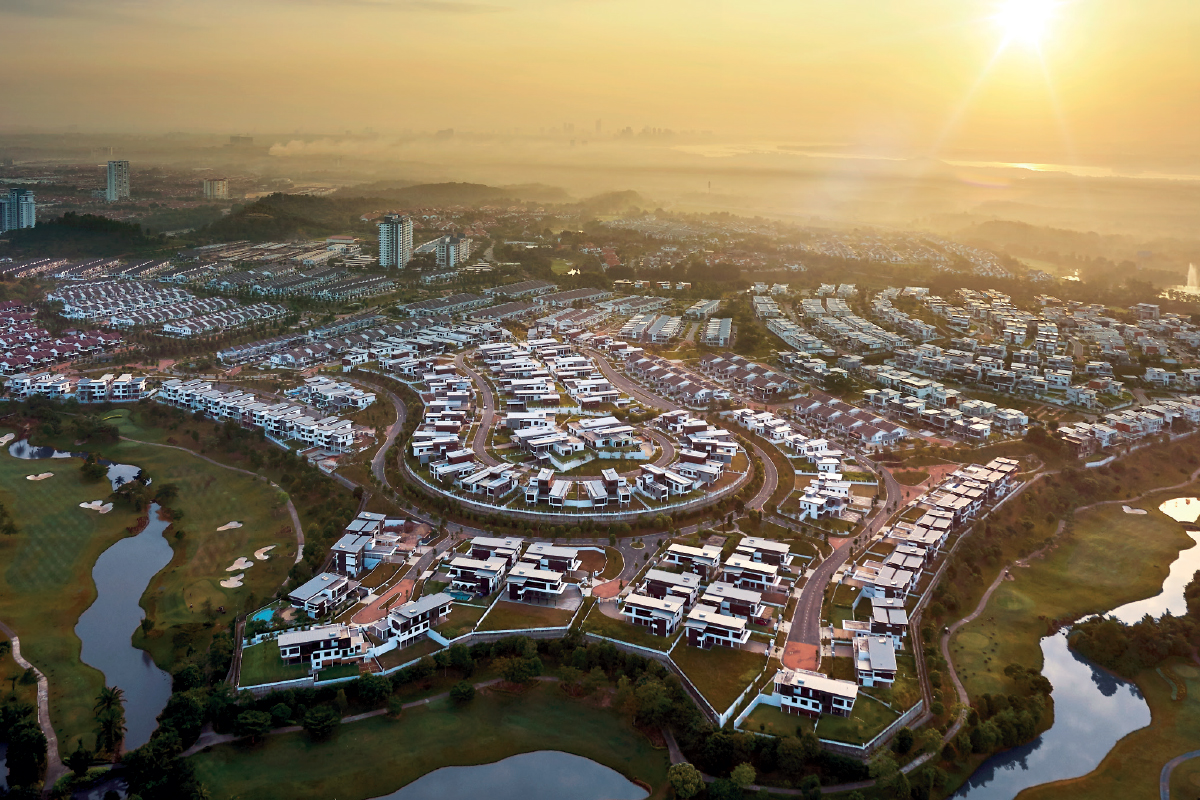

If you are evaluating property in Iskandar Puteri today, you are buying into the third act of a 20-year development story. The first act was the Nusajaya vision. The second was the reckoning with what actually got built. The third — the one you are entering — is shaped by what survived the hype cycle and what has grown around it. Understanding all three acts makes you a better-informed buyer.
Act One: The Nusajaya Vision (2006–2013)
The area now known as Iskandar Puteri was, in the early 2000s, largely palm oil and rubber estates owned by UEM Group and Khazanah Nasional — Malaysia’s two largest government-linked holding companies. The land was cheap, the location was strategic (close to Singapore via the Second Link), and the political ambition was significant.
In 2006, the Iskandar Malaysia development corridor was officially launched by then-Prime Minister Abdullah Ahmad Badawi. The 2,217 sq km corridor was divided into five Flagship Zones. Flagship Zone B — Nusajaya was the crown jewel: a planned city to be developed from scratch on UEM’s land holdings, with a projected population of 450,000 by 2025 and investment targets of tens of billions of ringgit.
The vision was ambitious and genuinely exciting. Within Nusajaya, distinct precincts were carved out:
- Medini — the free trade zone and commercial heart
- Edu City — international university and school campus cluster
- Kota Iskandar — the Johor state government administrative hub
- Puteri Harbour — a waterfront marina and lifestyle precinct
- Gerbang Nusajaya — an industrial and logistics zone near the Second Link
Alongside this government-led framework, private developers moved quickly. Gamuda Land launched Horizon Hills in 2007. Eco World (then operating as a different entity) began what would become Eco Botanic. UEM Sunrise launched East Ledang. The township sales pitch was compelling: freehold land, gated community, close to Singapore, and surrounded by a planned city that would transform the region.
Between 2010 and 2014, Nusajaya was the most talked-about property destination in Malaysia. International media covered it. Analysts cited it as one of Asia’s most ambitious urban development projects. Property prices in the townships rose sharply. Buyers who purchased in 2007–2010 saw values increase 40–80% by 2014.
Act Two: The Reckoning (2014–2022)
The hype cycle peaked around 2013–2014 and the correction was sharp. Several things happened simultaneously:
First, Chinese developer mega-projects arrived. Country Garden’s Forest City — a four-island artificial development on reclaimed land — was launched in 2014 with marketing that dwarfed anything Nusajaya’s domestic developers could match. The scale of Forest City (targeting 700,000 residents) created supply shock anxiety across all of Iskandar Malaysia. International investors who had been buying in Nusajaya reassessed.
Second, the Nusajaya commercial thesis underdelivered. Medini’s office towers did not fill with multinational tenants. The convention centre was delayed. The knowledge economy cluster around Gleneagles did not materialise at the scale promised. By 2016, Nusajaya’s commercial vacancy was conspicuous, and the media narrative flipped from “Asia’s next great city” to “Malaysia’s most overhyped development.”
Third, the rebranding happened. In 2019, Nusajaya was officially renamed Iskandar Puteri — a name chosen to emphasise its identity as an established city rather than an aspirational master plan. The rename was partly administrative (aligning the name with the Iskandar Puteri parliamentary constituency) and partly an attempt to distance the area from the Nusajaya brand, which had accumulated negative connotations.
For property buyers who had purchased in the 2012–2015 peak period, the years from 2016 to 2022 were frustrating. Prices stagnated or declined. Rental demand was soft. The area was functional but not thriving.
What actually got built — the permanent infrastructure
The key insight from Act Two is this: while the commercial thesis underdelivered, the residential and institutional infrastructure largely got built. And infrastructure, unlike speculative commercial plans, does not disappear when sentiment turns.
By 2022, Iskandar Puteri had:
- Three mature, well-managed gated landed townships (Horizon Hills, Eco Botanic, East Ledang) with tens of thousands of residents
- Kota Iskandar fully operational as the Johor state government seat
- Edu City with multiple international schools and university campuses open and accredited
- Gleneagles Hospital Medini operational
- Legoland Malaysia Resort open and generating tourism
- The Second Link and its approach infrastructure improved
- Wide, well-maintained roads throughout the area
- Utilities (electricity, water, broadband) at full capacity
The permanent infrastructure that was the foundation of the Nusajaya vision was largely in place. What was missing was the population density and commercial activity to make it feel like a real city. But foundations do not disappear. They wait.
Act Three: The JS-SEZ revival (2023–present)
The third act began with the post-COVID normalisation of cross-border movement in late 2022, and gained decisive momentum with the JS-SEZ announcement in January 2024. Suddenly, the existing infrastructure that had been dismissed as “built too early” was repositioned as a ready-made platform for the special economic zone.
The difference between Act One and Act Three is important. In Act One, the thesis was that building infrastructure would attract people. In Act Three, the thesis is that the JS-SEZ’s tax incentives and bilateral government backing will attract companies, and those companies will bring people to an area that already has the infrastructure to receive them.
That is a more credible sequence. The speculative element — “if you build it, they will come” — has been partially replaced by a policy-driven pull mechanism that makes corporate relocation financially attractive on its own terms.
What buyers today are actually inheriting
When you buy property in Iskandar Puteri in 2026, you are not buying a promise. You are buying into:
- An established residential community with genuine schools, hospitals, and daily amenities
- A functioning state government capital that anchors long-term institutional demand
- Freehold land titles in gated townships maintained by credible, listed developers
- A bilateral government commitment to economic zone development that carries more political weight than any single developer’s marketing pitch
- A market that has already passed through a hype cycle and a correction — the speculative froth of 2013–2014 is gone; what remains is the structural core
The Nusajaya story failed in part because it was a plan without a mechanism. The Iskandar Puteri story in 2026 has both the built infrastructure from Act One and the policy mechanism from Act Three. That combination is meaningfully different from where the area was a decade ago, and it is the context that should frame your evaluation of any property purchase here.