
Every property investor in Johor Bahru eventually asks this question. Not whether the price is right, not whether the developer is credible — but whether there will be real people paying real rent. That question is worth taking seriously. So let’s look at the numbers.
Start with the bigger picture: where are Malaysians?
Malaysia’s Human Resources Minister V. Sivakumar confirmed in March 2023 that 1.86 million Malaysians have migrated overseas. Of that total, 1.13 million — more than 60% — are residing in Singapore as of 2022. That is not a rumour or an estimate. It is the official figure from the Ministry of Economy and the Department of Statistics Malaysia.
In addition to those who live there permanently, another 350,000 Malaysians cross the causeway every single day for work — travelling from JB and returning the same evening. The two groups together represent an enormous concentration of working Malaysians whose daily lives are anchored to the Singapore-JB corridor.
Who exactly are these 1.13 million?
They are not a homogeneous group. According to the Ministry of Economy data, their primary reason for being in Singapore is employment: 62% are there for work, 38% for other purposes including family and education. When you look at their employment profile:
- 80% hold a full-time job with a formal contract — meaning stable, regular income
- Monthly income ranges from SGD 1,500 to SGD 3,559, with an average of SGD 2,500
- 89.4% are on full-time permanent contracts — not gig work, not seasonal
- The largest single salary band (66.7%) falls between SGD 2,000 and SGD 3,999 per month
At SGD 2,500 average salary — and with the ringgit currently trading at around RM 3.50 to SGD 1 — that is a purchasing power of roughly RM 8,750 per month. These are not low-income workers. These are people with stable employment and meaningful spending capacity.
One other figure is worth noting: 32% of the 1.13 million are Johoreans. The remaining 68% came from other states. That is significant. It means a majority of Malaysians currently working in Singapore did not grow up in Johor — they have no family home to return to here. When they consider moving to JB, they will need to rent.
How many of them are actually potential JB renters?
Not all 1.13 million are candidates. Some have Singapore PR status. Some already commute daily. Let’s work through the numbers:
- Start with: 1,130,000 Malaysians working in Singapore
- Subtract: 540,000 who hold Singapore Permanent Residency (they have settled status)
- Remaining: 590,000 non-PR Malaysians on work passes
- Subtract: 350,000 who already commute daily from JB (they have a home here)
- Remaining: approximately 240,000 Malaysians currently renting or staying in Singapore without a permanent arrangement in Johor
That is the figure to hold in mind: 240,000 working Malaysians in Singapore who do not own or rent in JB today. They are not all going to move. But even a fraction of that pool, prompted by the right shift in convenience or cost, represents a significant rental demand base.
There is a second group: Singapore retirees
The Singapore dollar has risen from approximately SGD/MYR 2.8 in 2018 to around 3.6 by 2024. Every Singaporean retiree who moves to JB stretches their CPF savings significantly further — the same pension funds roughly 29% more in ringgit terms than they did six years ago.
According to Singapore’s Department of Statistics, as of June 2023, there are 700,000 Singapore citizens aged 55 and above. If you assume half are part of couples (350,000 household units) and even 20% consider retiring in JB, that is a potential pool of 70,000 households. JB has long been a retirement destination for older Singaporeans who want lower living costs without giving up proximity to family and healthcare in Singapore.
This group does not rent the same way working migrants do — they tend to seek longer-term stays, quieter locations, and amenities. But they represent a distinct and growing demand segment that JB Town, with its established hospitals, malls, and services, is well positioned to absorb.
What changes when RTS opens in 2027?
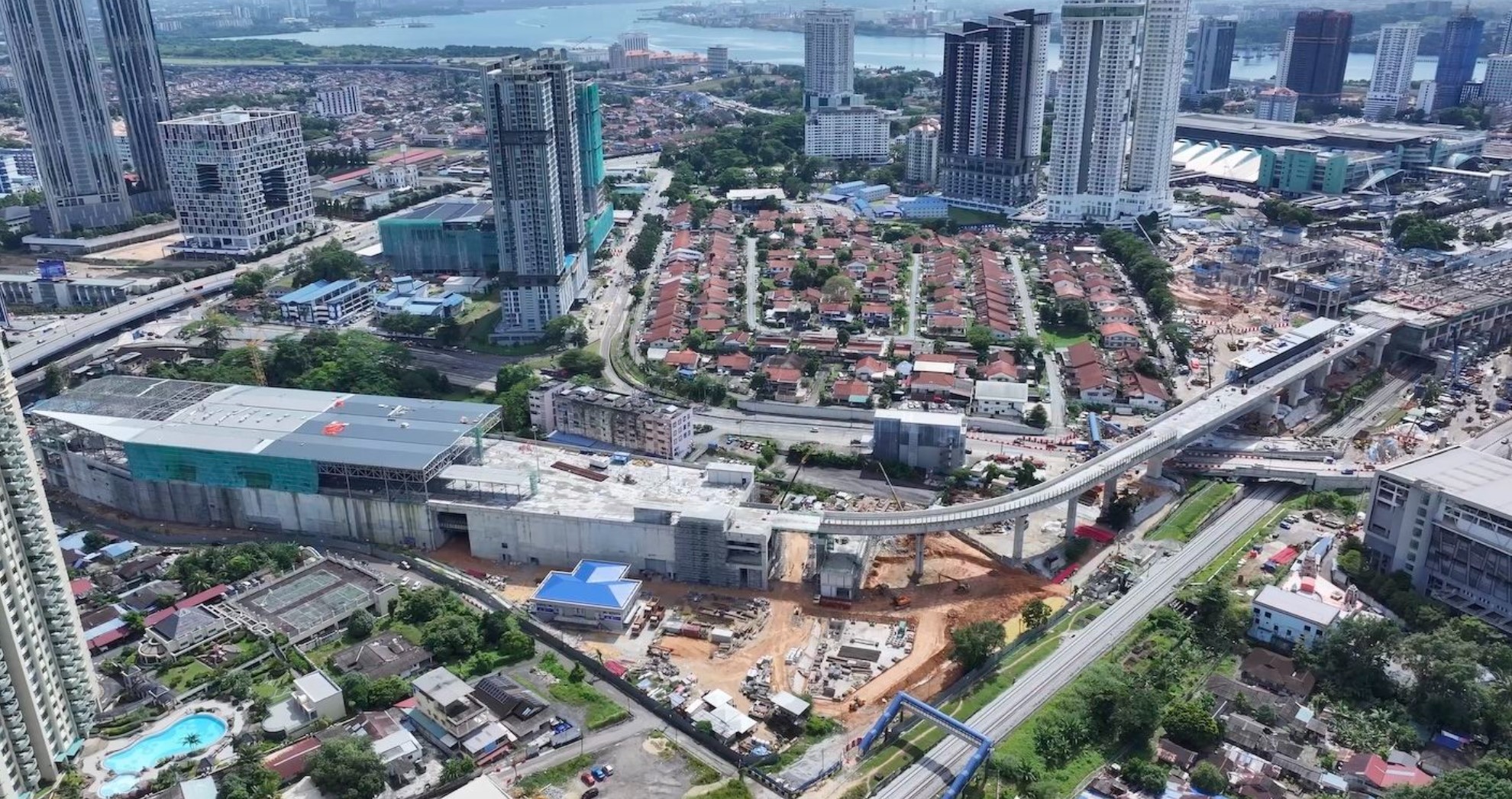
The Rapid Transit System (RTS) Link connecting Woodlands North (Singapore) to Bukit Chagar (JB) is scheduled to open in 2027. The project specifications tell a specific story:
- 6 minutes travel time from Woodlands North to JB Bukit Chagar
- A train every 4 minutes during operating hours
- 10,000 passengers per hour capacity
- Estimated 40,000 passengers per day at opening
For context: 40,000 daily riders is a substantial number for a single rail link. The question is not whether people will use it. The question is what they will do when they get off at Bukit Chagar — which sits in the heart of Johor Bahru Town.
A 6-minute train ride fundamentally changes the cost-benefit calculation for someone who currently pays SGD 2,000 or more per month to rent a room in Singapore. If they can rent a full unit in JB for the equivalent of SGD 700–900 and still reach their Singapore workplace in under 20 minutes door-to-door, the financial incentive is substantial.
And it is not just the RTS
The Singapore government separately announced a full redevelopment of the Woodlands Checkpoint (WCP). Once completed, the new checkpoint aims to reduce peak-hour car clearance time from the current 60 minutes to 15 minutes. The redeveloped WCP will be approximately five times the size of the current facility, incorporating automated in-car immigration clearance systems.
This matters for the population who cross by car: families, professionals with variable schedules, people who need flexibility. If the car crossing becomes reliably 15 minutes rather than unpredictable hours, a different segment of the market — one that previously could not tolerate the commute — may reconsider JB as a place to live.
So — will there be enough people?
Here is what the data tells us:
- There are currently 240,000 Malaysians working in Singapore without a JB home base
- There are potentially 70,000 Singaporean households in the retirement age bracket who could consider JB
- The RTS will put 40,000 daily riders through Bukit Chagar station starting 2027
- The Woodlands Checkpoint upgrade will make car crossings faster for those who drive
- The SGD/MYR exchange rate continues to make JB significantly cheaper for those earning in Singapore dollars
What the data cannot tell you is how quickly this population actually moves — or whether JB Town specifically captures that demand, versus Iskandar Puteri or other parts of Johor. It also cannot tell you whether supply — the number of units being built or launched — stays ahead of, behind, or in balance with the potential tenant pool.
Those are questions worth sitting with. Because the answer is not the same in every year, at every price point, or in every location within JB.