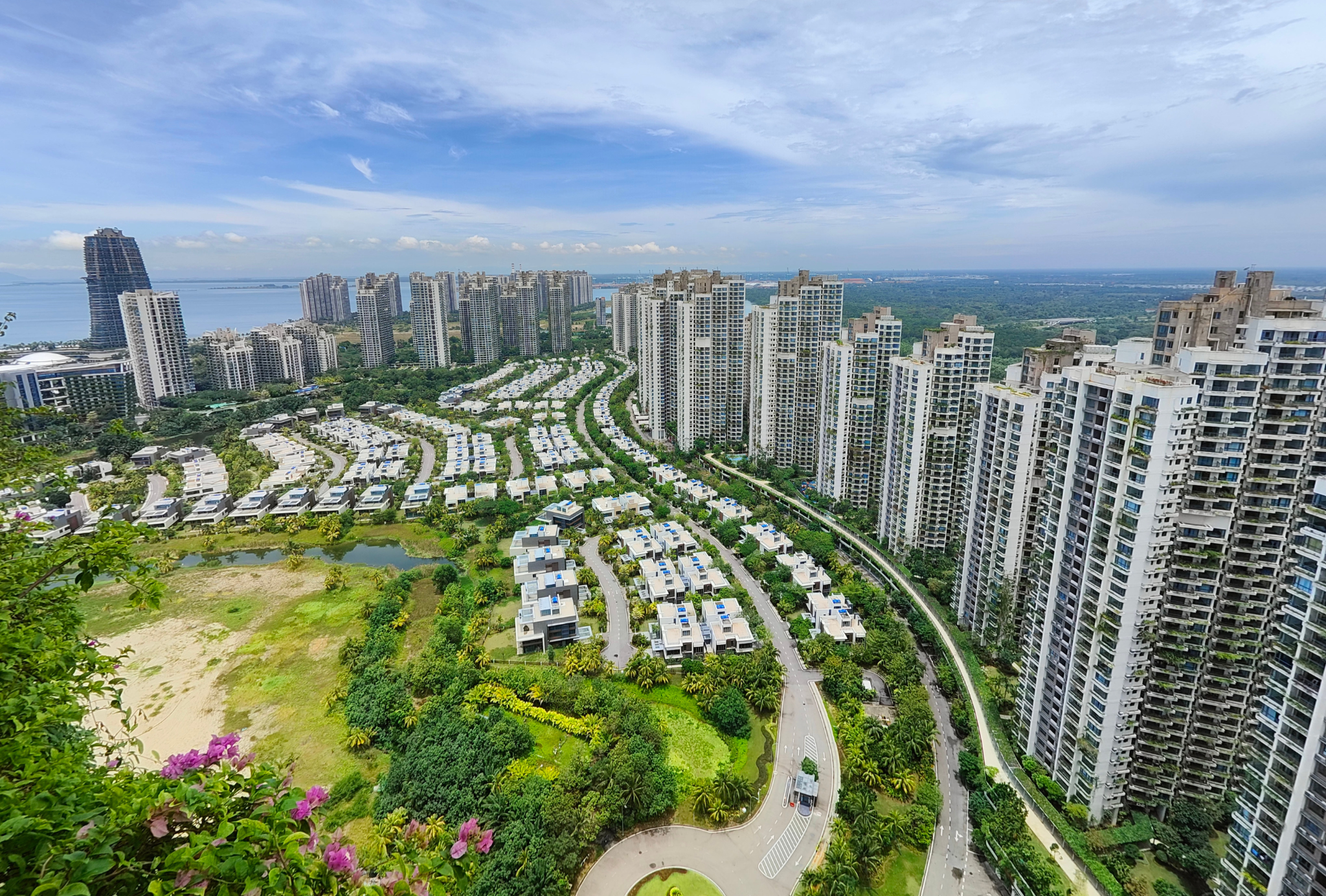

The "ghost town" label has followed Forest City since around 2020. It appeared in international headlines, spread across social media, and stuck — to the point where many buyers today dismiss Forest City without looking at current data. That is a mistake. But so is ignoring the real problems that created the label in the first place.
Where did the ghost town narrative come from?
The criticism was not invented. Forest City was developed by Country Garden Pacificview, a subsidiary of China's Country Garden Group, and launched aggressively from around 2016 — primarily marketed to Chinese mainland buyers as an overseas property investment. At its peak ambition, it planned to house 700,000 people across four man-made islands.
Then several things went wrong at once. China tightened capital controls in 2017, making it harder for Chinese nationals to move money overseas. The Malaysian government introduced a moratorium on new foreign property purchases in 2018. COVID-19 shut borders completely from 2020 to 2022. And Country Garden Group itself ran into severe financial difficulties in China, casting doubt on the developer's ability to complete remaining phases.
The result: a large-scale development with very few actual residents, empty retail, and a landscape that looked exactly like what journalists wanted to call a ghost town. The label was, at that point in time, fair.
What has actually changed since 2024?
The situation in 2026 is materially different from 2020 or even 2022. Several specific developments have shifted the picture:
- Special Financial Zone designation (September 2024): The Malaysian government formally launched Forest City as an SFZ, backed by five pieces of amendment legislation. This brought 0% tax for family offices, 15% income tax for knowledge workers, and 5% corporate tax for qualifying financial services companies — gazetted law, not a press release.
- Johor-Singapore Special Economic Zone (January 2025): Malaysia and Singapore signed a formal agreement making Forest City one of nine flagship zones within the broader JS-SEZ — a bilateral government commitment, not just a developer promise.
- Resident population: Forest City now has close to 20,000 residents — still far below the 700,000 original vision, but meaningfully above the near-zero occupancy of 2020. The Malaysia Investment Facilitation Centre has co-located more than 10 government agencies on site.
- SFZ MM2H approvals: Between October 2024 and March 2026, 593 applicants received MM2H approval under the SFZ-specific programme — real occupants, not just buyers sitting on empty units.
- Golf course recognition: The Classic Course has ranked in Asia's Top 100 Golf Courses for seven consecutive years (2020—2026). The Legacy Course designed by Jack Nicklaus ranked 49th in Asia-Pacific 2024—2025. The resort hosts over 100 international tournaments annually.
Key data point: Over RM790 million in taxes paid to the Malaysian government, 10,000 jobs created, and partnerships with over 190 local enterprises — figures that indicate sustained economic activity rather than a dormant site.
Important context: 70% of properties have reportedly been sold, but occupancy remains far below that figure. Many units are owned but not lived in — a distinction that matters significantly for rental yield calculations.
What are the remaining real risks?
- Occupancy gap is still large. 20,000 residents against a 700,000 original target is 3% of the development's full vision. Full activation depends on SFZ companies and family offices actually setting up operations — a medium-term process, not an overnight switch.
- Developer financial background. Country Garden Group's debt difficulties in China are well-documented. Forest City's Malaysian operations are separate and the government has committed to the SFZ regardless, but buyers in uncompleted phases should assess this risk carefully.
- Rental yield is currently low. With many units owned but unoccupied, the rental market is not active enough to generate strong yields. Buyers expecting immediate rental income should approach with caution.
- Retail and amenities still developing. Day-to-day retail density is not yet at a level that makes Forest City fully self-contained. Residents still rely on the mainland for many everyday needs.
So — ghost town or opportunity?
Neither label is accurate on its own in 2026. The ghost town label belongs to 2020—2022. What exists today is something more nuanced: an underoccupied but actively developing SFZ-designated island, backed by genuine government policy commitment and bilateral Malaysia-Singapore agreement, with real infrastructure, real residents, and real institutional presence — but still in the early stages of activation.
For buyers, this means Forest City is a medium-to-long term play with a real policy tailwind, not a distressed gamble or a finished product. If you are buying for lifestyle (golf, island environment, Singapore proximity at a fraction of Singapore prices), the case is already there. If you are buying purely for capital appreciation or rental yield on a short timeline, the risk profile is higher and the timeline needs to be realistic.
The ghost town narrative was true. The question now is whether the conditions that created it have changed enough to warrant a different conclusion. Based on 2024—2026 developments, I think they have changed materially — but the full story is still being written.
Want a straight answer for your specific situation?
Tell me your budget, purpose, and timeline. I will tell you honestly whether Forest City makes sense for you — or whether a different district is a better fit.
Chat with Sam on WhatsApp